


AI in Marketing 2026: From Tool Chaos to Intelligent Content Automation
AI in Marketing 2026: From Tool Chaos to Intelligent Content Automation
AI is no longer just another marketing trend.
It is fundamentally changing how marketing teams create content, build workflows, scale operations, interact with customers, and measure performance.
At the recent AI in Marketing Conference in Zurich, one theme came up repeatedly across keynotes, workshops, and conversations with marketing leaders:
The biggest challenge is no longer access to AI tools.
The real challenge is understanding which use cases actually matter.
Because in today’s market, every platform looks impressive on the website. Every vendor promises automation, intelligence, personalization, and agents. But many marketing teams are still struggling to move from experimentation to measurable business impact.
And that creates a new kind of complexity: tool overload without operational clarity.
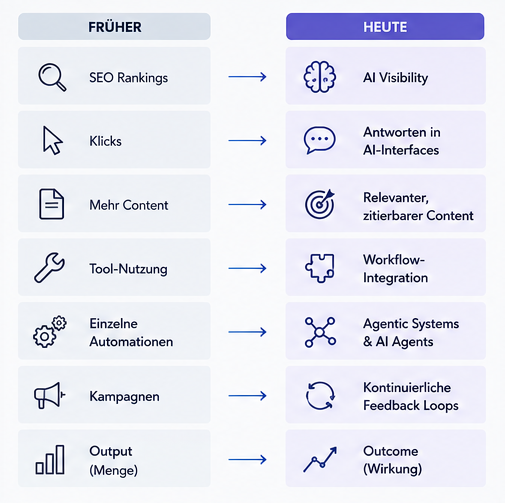
The AI Marketing Shift
Marketing is currently moving through one of the biggest operational shifts in years.
The industry is evolving from isolated tools and campaign thinking toward integrated, AI-supported systems that continuously learn and optimize.
Instead of simply creating more content faster, leading teams are redesigning workflows around AI-assisted execution.
This changes how organizations think about:
- visibility
- content production
- customer interaction
- performance optimization
- workflow orchestration
- decision-making
The shift is not only technological.
It is organizational.
The Biggest Problem: Tool Jungle vs. Real Business Value
One of the most common themes in conversations with marketers at the conference was surprisingly practical:
“How do we know which tools actually matter?”
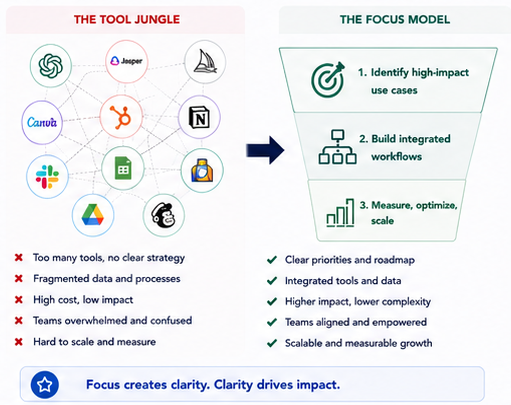
Most teams are overwhelmed by the speed of innovation.
New AI tools appear weekly. Every platform claims to solve productivity, personalization, SEO, content creation, analytics, customer interaction, or automation.
But the problem is that many organizations start with tools instead of use cases.
That often leads to fragmented workflows, disconnected data, duplicated processes, and AI initiatives that never scale beyond isolated experiments.
The best-performing teams approach AI differently.
They start with a business bottleneck first.
For example:
- repetitive content production
- slow campaign execution
- inefficient customer support
- missing personalization
- scaling SEO content
- social media repurposing
- sales enablement
- knowledge management
Only then do they evaluate which systems or workflows support that goal.
Focus creates impact.
Not the number of subscriptions.
Why Many AI Projects Still Fail
Despite the hype, many AI initiatives still struggle to deliver measurable results.
Research and industry discussions consistently point to the same reasons:
- AI is introduced without redesigning workflows
- teams use AI tools in isolation
- ownership is unclear
- change management is underestimated
- data quality and integrations are weak
- organizations focus on technology instead of operational transformation
At the conference, several speakers emphasized that successful AI adoption is less about the model itself and more about organizational readiness.
One particularly important insight was the role of active change management.
Companies that scale AI successfully usually invest heavily in internal enablement, training, AI champions, and clear governance structures.
Because AI adoption is not simply a software rollout.
It changes how teams work.
Search Is Changing: From SEO to GEO to AI Visibility
Another major topic was the evolution of search.
Traditional SEO is no longer the full picture.
AI Overviews, AI assistants, conversational interfaces, and generative search experiences are fundamentally changing how users consume information online.
The question is no longer only:
“How do we rank?”
The new question is also:
“Will AI systems understand, select, and cite our content?”
This creates a major shift in content strategy.
Content now needs to become:
- more structured
- more extractable
- easier to interpret
- entity-rich
- context-driven
- citation-friendly
Several sessions discussed how AI systems currently favor highly structured comparison pages, product lists, and so-called “listicles” because they are easier to parse and summarize.
Another important insight:
longer content alone does not automatically increase visibility.
Many AI systems heavily prioritize content that is clear, front-loaded, and directly answer-oriented.
This is where GEO, Generative Engine Optimization, becomes increasingly relevant.
Human-in-the-Loop Still Matters
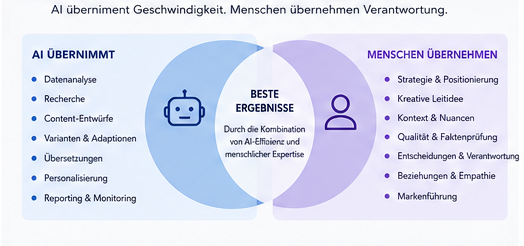
One of the most important takeaways from the conference was that AI is incredibly powerful, but still requires human oversight.
Several talks explored the risks of fully autonomous systems, AI hallucinations, emotional dependency on AI agents, and the broader societal impact of increasingly synthetic online environments.
The conclusion was not anti-AI.
It was pragmatic.
AI works best when humans stay actively involved in the right places.
This is especially true in marketing, where quality, trust, compliance, brand positioning, and emotional nuance matter deeply.
The most effective organizations define clear human-in-the-loop checkpoints throughout the workflow.
For example:
- strategic direction
- brand tone validation
- fact checking
- legal review
- editorial oversight
- final approval
The goal is not to slow AI down. The goal is to ensure quality scales together with speed.
What Effective Content Automation Actually Looks Like
Content automation is often misunderstood. Many companies think automation simply means generating blog posts with AI.
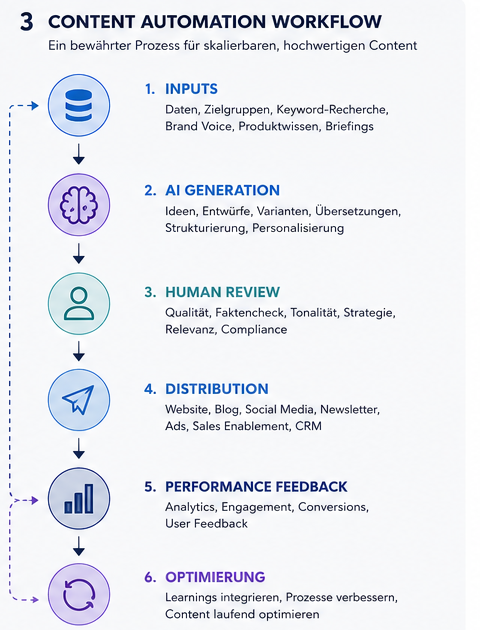
But scalable content automation is actually a connected operational system.
The most successful approaches combine:
- structured data
- AI-assisted production
- workflow orchestration
- human validation
- performance feedback loops
- integrated distribution
Instead of creating one isolated asset, modern marketing systems continuously transform and repurpose content across channels.
A single webinar, report, or podcast can become:
- blog posts
- social content
- newsletters
- ad variations
- landing pages
- sales collateral
- customer education assets
And increasingly, these workflows are becoming agentic.
That means AI systems can independently coordinate subtasks, trigger processes, retrieve information, optimize outputs, and improve over time through feedback loops.
This is where marketing is heading:
from disconnected tools toward autonomous marketing systems.
From Toolstack to Autonomous Marketing Systems
One particularly exciting discussion at the conference focused on the transition from isolated AI tools toward connected, agentic ecosystems.
Instead of marketers manually coordinating dozens of platforms, future systems will increasingly orchestrate workflows autonomously.
This includes:
- customer understanding
- content generation
- campaign optimization
- interaction management
- analytics
- learning systems
The key difference is integration.
AI only becomes truly valuable when systems can work together across workflows instead of remaining isolated productivity tools.
This also explains why many organizations still struggle today:
they adopt AI tools individually without redesigning the operating model around them.
The future is not “more tools.”
The future is connected intelligence.
[GRAFIK 7 HIER EINFÜGEN: From Toolstack to Autonomous Marketing System]
The Real Best Practice: Focus
The most successful marketing teams are not trying to automate everything at once.
They focus on high-impact use cases first.
Examples include:
- SEO content briefing generation
- content repurposing
- social media automation
- campaign production workflows
- newsletter personalization
- sales enablement content
- AI-supported customer support
- internal knowledge systems
- agentic workflows for repetitive marketing tasks
The difference is not the tool itself.
The difference is operational prioritization and execution.
Conclusion
Marketing is no longer experiencing a simple tool shift.
It is experiencing a system shift.
AI is changing how visibility works, how content is produced, how teams collaborate, and how organizations scale customer interaction.
But the biggest challenge remains deeply human:
- Which use cases actually matter?
- Which workflows should be redesigned?
- Where is human oversight essential?
- How do teams move from experimentation to implementation?
At Dreamleap, this is exactly where we help companies.
We support marketing teams in navigating the AI tool landscape, identifying high-impact use cases, and implementing them through practical, hands-on workshops and operational AI systems.
Because ultimately, the companies that win will not be the ones with the most AI tools.
They will be the ones that integrate AI meaningfully into real workflows and create measurable business impact.
Want to Build Your Own AI Agents?
This is exactly where we come in. We help marketing teams:
- navigate the jungle of tools
- identify relevant use cases
- and put them into practice straight away
Not just theory. But hands-on.
In our sessions, teams:
- build own AI workflowseigene AI-Workflows
- AI Agents
- and integrated marketing systems
👉 https://www.voicetechhub.com/how-to-build-agents
After all, it isn’t the team with the most tools that comes out on top.
It’s the team that integrates AI into its own processes in a concrete, meaningful and measurable way.