

AI-Tokenomics: How a Few Words Become Millions of Tokens
How many tokens are in this sentence?
Probably more than it has words.

AI models do not read text word by word. They break it down into small pieces. A short word can be one token. A longer German word can consist of several. Punctuation marks count, too.
Tokens are therefore not mysterious digital coins. They are simply the small units of text that a language model works with.
The text above this line already amounts to approximately 120 to 160 tokens, depending on the model and tokenizer.
And now it gets interesting: every one of these tokens has to be processed. With a short chat, this hardly matters. With large documents, many users, or an AI agent, the calculation suddenly looks very different.

Try it yourself: Enter any text and watch how it turns into individual tokens: https://huggingface.co/spaces/Xenova/the-tokenizer-playground.
Reading costs. Writing does, too.
When you ask an AI model a question, it first reads the input and then generates an output. Both are measured in tokens.
Input includes not only your question, but also previous messages, work instructions, documents, or search results. Output includes the answer as well as possible summaries, structured data, or commands to other systems.
The visible question is therefore often only a small part of the total consumption.
Many providers charge per million input and output tokens. Output is often more expensive than input.
When do you reach one million tokens?
One million sounds like a lot. For a single chat question, it is. As a rough rule of thumb, one million tokens correspond to several hundred thousand words. In English, around 750,000 words are often cited; for German, the figure can differ because words are broken down differently.
But companies do not work with a single text. They have contracts, e-mails, meeting minutes, policies, and support cases. And they do not ask one question, but hundreds.
A simplified example:
Process Tokens
Question and work insturction 1’000
Relevant document excerpts 7’000
Answers 1’000
Total per request 9’000
After around 112 such requests, the first million has been reached. At 500 requests per working day, that would already be 4.5 million tokens. Per day.
And this is still a workflow with only one model call.
What does it actually cost?
The basic calculation is simple:
Input-Tokens × input price + output tokens × output-price.
Let us take a purely illustrative model that costs 3 US dollars per million input tokens and 15 US dollars per million output tokens. One million input tokens then costs 3 dollars. If an additional 200,000 tokens are generated, that adds another 3 dollars. Total: 6 dollars.
That sounds harmless.
But now the same process runs every day for different teams or customers. 6 dollars becomes 60. Then 600. And if long documents are sent along again at every step, the counter rises much faster.
There can also be costs for search services, databases, image models, or external tools. Token costs are not always the whole bill. But they are often the clock that drives it.
The important question is therefore not only: “How expensive is the model?”
It is: “How many model calls does our process require, and how much context do we send with each one?”
Then the agent gets to work.
So far, we have looked at a simple exchange: question in, answer out.
An AI agent can plan a task, search for information, call tools, compare results, and check its own answer.
For example, you might write:
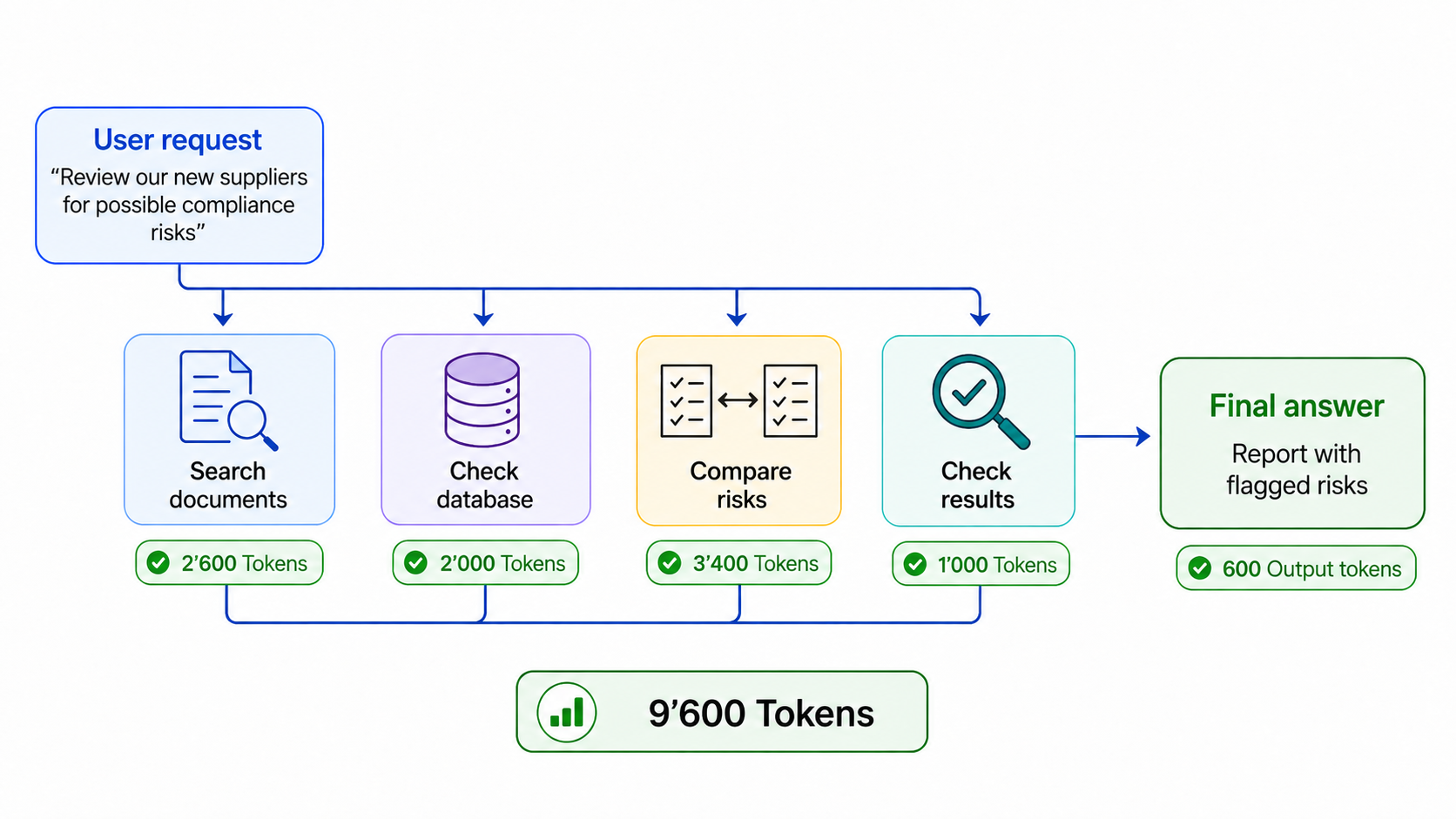
“Check our new suppliers for potential compliance risks.”
The agent could retrieve supplier data from the ERP, search internal policies, check external sources, compare results, investigate unclear cases again, and create a report.
For you, it was one assignment. In the background, it may have involved eight, twelve, or twenty work steps.
It is not that millions of tiny tokens run through the system like ants. Technically, the agent starts multiple model calls and subtasks, some sequentially and some in parallel. With every call, information is read and written again.
Think of a chat as one person sitting at a desk. An agent is more like a small project team. One person searches for documents, a second checks data, and a third summarizes everything. The team can work faster. But each desk has its own token counter.
More tokens are not automatically bad.
You might now think: The fewer tokens, the better.
It is not that simple.
An agent that completes a full compliance check with 30,000 tokens in two minutes can be more economical than a cheaper chat whose answer then has to be checked manually for an hour. The decisive factor is not only the price per token. It is the price per reliably completed task.
Good agents do not load the entire company archive for every question. They search for relevant passages, use smaller models for simple steps, and stronger ones only where they are needed. They do not unnecessarily repeat the same context. And they know when the task is complete.
Good tokenomics does not mean: consume as little as possible.
It means: give every token a meaningful job.
Where do tokens do their work?
So far, we have focused on quantities and prices. But the tokens also have to be processed somewhere.
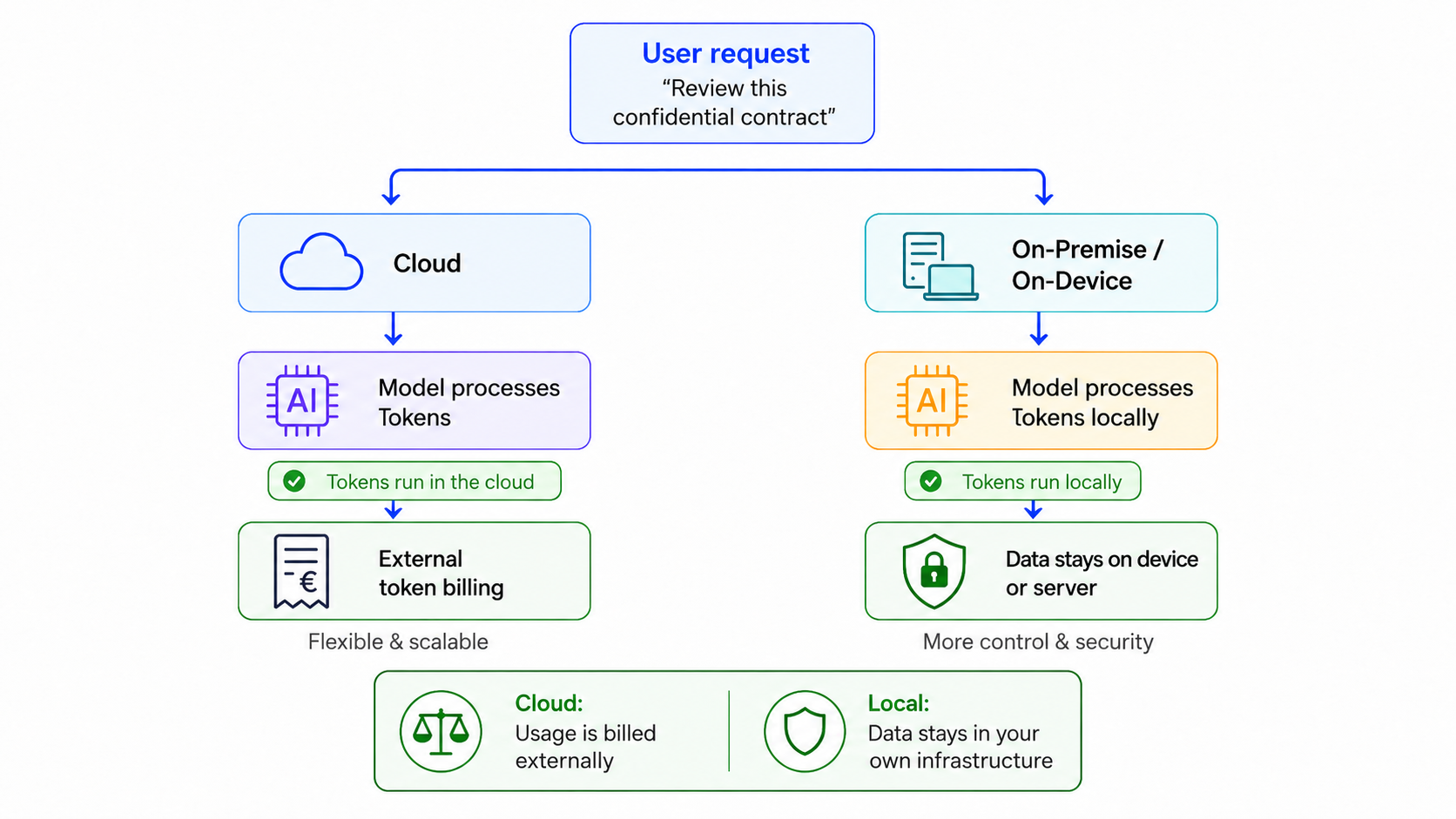
In many cases, this happens in the cloud. Questions, documents, and context are sent to the model provider’s infrastructure. The model processes the tokens there, and usage is billed.
This is flexible. Companies can get started quickly, use different models, and scale as needed.
There is, however, a second option: the model runs on-premise on the company’s own infrastructure or directly on-device. Tokens are processed there, too. They do not disappear, and the computation is not free. Hardware, energy, maintenance, and operations remain real costs.
The key difference: With a fully local setup, prompts, documents, intermediate results, and answers do not have to leave your own infrastructure. Everything stays on the device or your own servers. At the same time, there is no external charge for every individual input and output token.
For confidential contracts, personnel data, financial information, or internal processes, this is not just a cost issue. Above all, it is a security and control issue.
Local does not automatically mean secure, however. An on-premise solution also needs access controls, encryption, updates, and governance. But it reduces one central attack surface: sensitive data does not have to be transferred to an external service for every AI step.
The small units behind the big decisions.
Tokens are tiny. The architecture behind them is not.
A chat may involve a few hundred or thousand tokens. With an agent that searches documents daily, connects systems, and handles subtasks in parallel, that can quickly become millions.
Three questions then arise:
- What does the entire workflow cost?
- What business value does it create?
- And where should the data remain while it is being processed?
dreamleap develops secure AI agents that orchestrate work across existing enterprise systems. Depending on the requirements, they can run in the cloud, on-premise, or on-device. The local variants are particularly suited to sensitive and regulated use cases where data control, governance, and security are critical.
This makes it possible to determine not only what an agent does, but also where its tokens do their work.
Because in the end, the most important question is not: “How do we prevent token consumption?”
It is:
“How do we use tokens where they can safely create the greatest value?”.