

AI Agents Are Coming: Are Companies and Employees Ready?
AI Agents Are Coming: Are Companies and Employees Ready?
Let’s imagine a perfectly ordinary Monday morning. An administrative specialist in the credit department opens her inbox and finds 40 new requests. In the past, she would have read each one individually, searched for the relevant documents and eventually begun processing them sometime in the afternoon. Today, a chatbot helps her formulate the replies. That saves time. She still types in each request herself, however, and makes every decision on her own.
But what if, by six o’clock that morning, a system had already reviewed those 40 requests, compiled the relevant documents, responded directly to the obvious cases and placed only the ten genuinely tricky cases, with a recommendation, on her desk? That is precisely the distinction many companies are currently grappling with, even if the term for it, “AI Agent,” has begun to sound somewhat overused.
The Difference Between Responding and Acting
At its core, a chatbot or copilot is a very capable counterpart. You ask a question, and it answers. You request a draft, and it provides one. The person remains in control, step by step. That is valuable, but it remains reactive: without a prompt, nothing happens.
An AI agent works differently. It is given a goal rather than a question: for example, “automatically process incoming loan applications under 5,000 francs”, and independently determines which steps are necessary. It retrieves data from the CRM, checks it against predefined rules, writes a response, perhaps even sends it, and, if something is unclear, brings a human into the loop. The agent plans, uses tools and makes intermediate decisions, often across multiple systems, without someone watching every step.
The difference is therefore not merely one of degree. It is the leap from “I’ll help you with your task” to “I’ll take care of this task for you, within the scope of what you have allowed me to do.” And it is precisely that final qualification, within the scope of what has been allowed, that makes the issue both exciting and challenging for companies.
When Software Suddenly Helps Make Decisions
As soon as a system no longer merely suggests but takes action, something fundamental shifts: the question of responsibility. Who is liable if an agent posts an invoice incorrectly, makes a false commitment to a customer or sends sensitive information to the wrong place? “The AI did it” is not an answer that will stand up before a board of directors, an audit department or, if necessary, a court.
That does not mean companies should do without agents, quite the opposite, the potential is real. An insurer can pre-screen claims in minutes instead of days. An industrial company can automatically reconcile orders, supplier inquiries and spare-parts planning. A bank can accept customer inquiries around the clock and escalate only the complex cases. But each of these examples works only if someone has first asked the uncomfortable question: What exactly is this system allowed to do independently, and what is it not allowed to do?
This is new for many organizations. With a chatbot, it was often enough to say, “Let’s test it and see what happens.” That is no longer sufficient for an agent that can initiate payments, modify contracts or alter customer data. Such systems require clearly defined boundaries, approval processes for critical steps and complete traceability of what the agent did, when it did it and why.
Employees: From Executing to Supervising
For the workforce, this means a genuine shift in roles, not merely an increase in efficiency. The administrative specialist mentioned earlier will not become redundant, but her role will change. Instead of processing every request herself, she will conduct spot checks to verify that the agent made the right decisions. Instead of copying data, she will assess edge cases that still require human judgment. This may sound like less work, but it is often more demanding: you need to understand how the system arrived at a decision in order to recognize when it is wrong.
This is precisely where an underestimated danger lies. If a system is correct in 95% of cases, a certain complacency can quickly set in. Yet the remaining five percent are often exactly the cases in which it becomes costly if no one is paying attention. Companies that introduce agents without training their employees to remain critical are taking on a new risk they had actually intended to avoid.
At the same time, new areas of responsibility emerge. Someone has to maintain the rules according to which agents operate. Someone has to monitor whether the system’s behavior changes over time. And someone has to decide when an agent may take over a task and when it may not. These are not purely IT roles; they are experts from the departments themselves, who are now channeling their process knowledge in new ways.
Systems That Need to Work Together
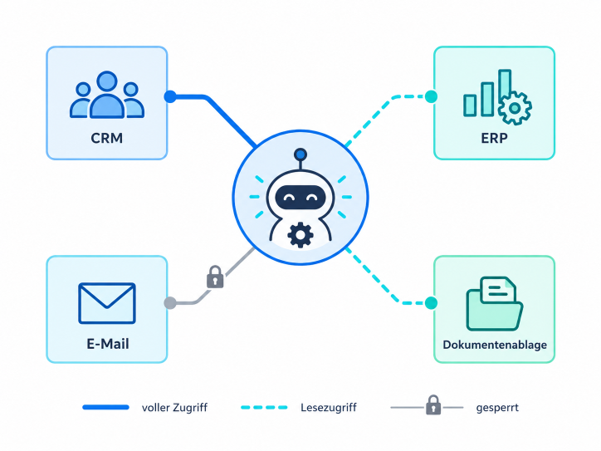
Technically, the greatest hurdle is rarely the AI itself, but rather the environment around it. A useful agent needs secure access to CRM and ERP systems, email inboxes and internal documents, but only with the appropriate permissions. Many companies realize only then how fragmented their system landscape is: missing interfaces, inconsistent data and processes that previously worked only because experienced employees knew where to look.
Then there is the security question, which carries very different weight for systems that act autonomously than it does for a chat window. Where is the data processed? Who can see what the agent is processing? What happens if an agent is compromised or processes faulty inputs? Particularly in regulated industries such as financial services, insurance and healthcare, this is not a side issue but a fundamental prerequisite before an agent can go live at all.
Preparation Instead of Hesitation, but Not Everything at Once
Many executives’ instinctive reactions are either euphoria or caution that turns into paralysis. Neither rarely leads to the desired outcome. A more sensible approach is a third path: start small, but take it seriously. Select a process that is limited enough to remain manageable, but important enough to make a real difference. Define clear boundaries for what the agent may do. Build in a feedback loop so that errors are identified quickly. And involve employees from the very beginning—not only once the system is already up and running.
The companies that will have a genuine advantage in one or two years are probably not those that introduced an agent first. They will be the ones that did the work properly: with clear responsibilities, traceable decisions and employees who understand what they are working with instead of blindly relying on a system.
This is precisely where specialized providers such as Dreamleap come in: addressing the question of how to build agents that can be securely integrated into existing corporate systems, respect clear boundaries and, depending on the requirements, be operated in the cloud, on-premises or directly on the company’s premises—particularly where data must not leave the organization at all for regulatory or security reasons. The real work rarely lies in the impressive language model itself, but in exactly the questions addressed in this article: Who is allowed to do what? What happens in cases of doubt? And how does the human ultimately remain the decision-making authority, rather than merely the one watching?
The Real Question
AI agents are not arriving as a distant vision of the future, but gradually and often more quietly than people expect—first in one department, then in another. The interesting question is therefore less whether a company is ready for agents in general. It is more this: For the first specific use case, is it clear who is responsible if something goes wrong, and do the employees who will work with it know that as well?
Anyone who can answer that question today is further ahead than it may feel.